The Indian Rupee Under Pressure: Why India's Currency Is Struggling in 2026
The rupee is hovering near record-weak levels as oil prices, geopolitical tensions, and importer demand weigh on it, with RBI intervention and billions in new inflows providing a buffer.
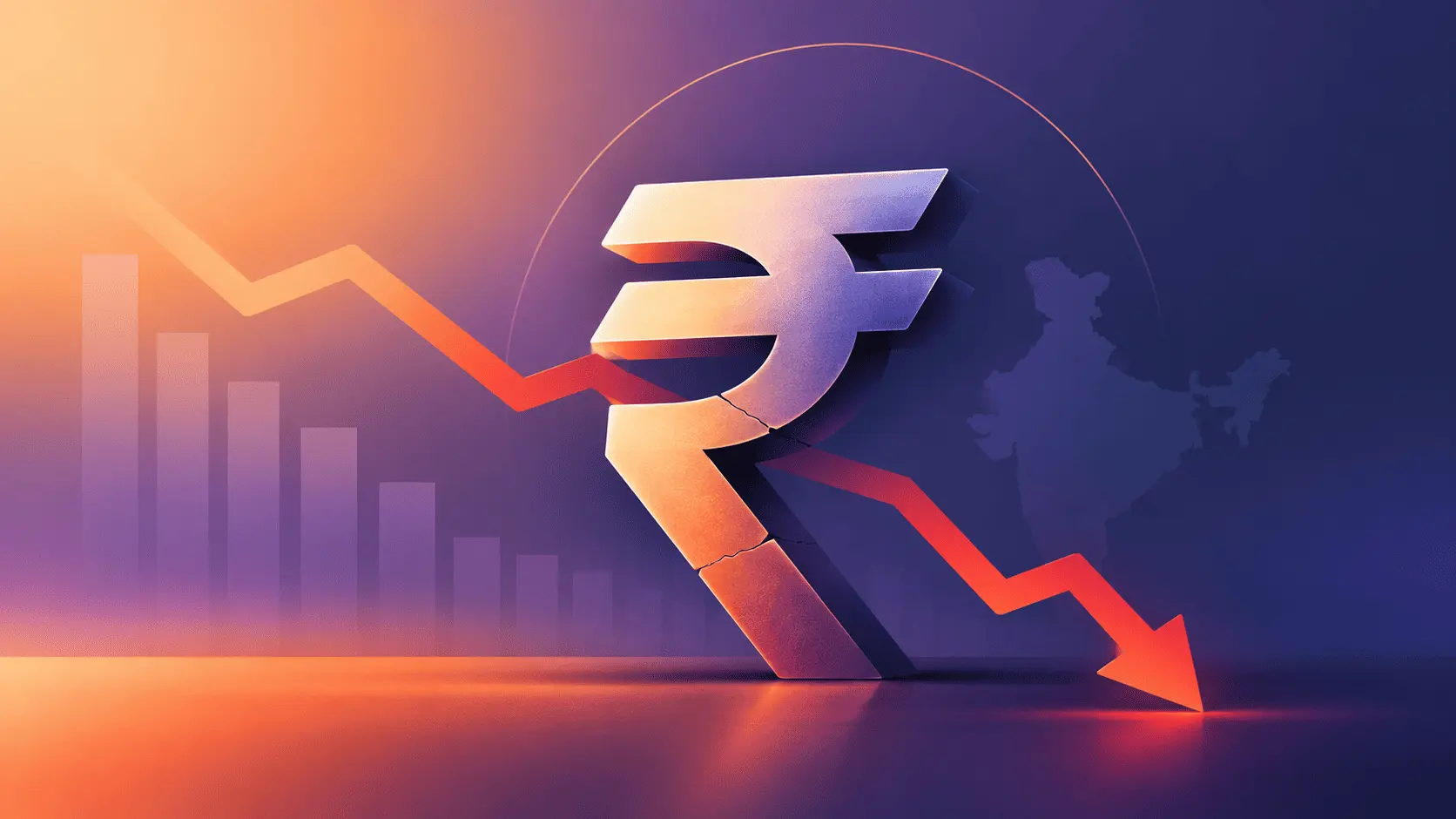
The result is an unusual situation. The rupee remains weak, but its movements have become remarkably subdued, and behind that stability are several forces pulling the currency in opposite directions.
Why is the rupee under pressure?
There isn't one single reason for the rupee's weakness. Instead, several pressures have arrived at the same time.
Oil is one of India's biggest vulnerabilities
India imports the vast majority of the crude oil it consumes, making the country particularly sensitive to movements in global energy prices. When crude becomes more expensive, Indian companies need more US dollars to pay for imports, which increases demand for dollars and can put additional pressure on the rupee.
This risk has become particularly important because of the continuing conflict involving Iran and uncertainty surrounding oil supplies from the Middle East. Brent crude was around $94 per barrel on Monday, after gaining sharply the previous week, and Morgan Stanley has warned that the oil market could remain in deficit through the fourth quarter of 2026 and the first quarter of 2027, with its Brent forecast reaching $100 per barrel in the fourth quarter. For India, prolonged high oil prices can create a difficult combination, higher import costs, greater dollar demand, and inflationary pressure, all at once.
The RBI is fighting back
The rupee's recent behaviour cannot be understood without looking at the Reserve Bank of India, which has been actively intervening in the foreign-exchange market to prevent the currency from weakening too quickly. Reuters reported that state-run banks have repeatedly been seen offering dollars, with traders believing the transactions were being conducted on behalf of the RBI, and that intervention has helped reduce short-term volatility significantly.
The effect has been substantial. The rupee's two-week realised volatility has fallen below 2 percent, while one-month implied volatility has dropped to around 4 percent, below its year-to-date average of 5.2 percent. In other words, the RBI isn't necessarily trying to make the rupee dramatically stronger, it appears to be trying to make its decline orderly.
India has also built a larger foreign-exchange buffer
There is another development working in India's favour. India's foreign-exchange reserves climbed to $716.9 billion as of August 14, according to data reported by Reuters, an increase of almost $10 billion in a single week and close to the country's record of $728.5 billion reached in February.
The increase has been driven partly by measures introduced by the RBI in June to attract foreign-currency inflows, including incentives related to overseas borrowing and foreign-currency deposits. By August 13, nearly $57 billion had flowed in through these measures, according to Reuters, and a separate Reuters report put the total inflow under the RBI's measures at nearly $73 billion. That gives the central bank significantly more ammunition to manage the currency.
But more dollars don't necessarily mean a stronger rupee
This is where the situation becomes more complicated. Large foreign-currency inflows might normally be expected to support the rupee, but the RBI has another objective, maintaining stability. Rather than allowing the rupee to appreciate sharply because of the inflows, the central bank can absorb foreign currency and add to its reserves, meaning the additional dollars can strengthen India's external buffer without necessarily producing a major appreciation of the rupee.
Reuters reported that bankers and analysts expect the RBI to continue prioritising orderly currency movements rather than outright appreciation. That distinction matters, the RBI may have the ability to defend the rupee without necessarily wanting to push it substantially higher.
The dollar is not the whole story
Interestingly, the rupee's weakness is occurring even as the US dollar has recently faced pressure against several major currencies. The dollar index fell to a multi-month low last week amid concerns surrounding US Treasury policy and expectations about Federal Reserve policy, yet the rupee has not benefited to the same extent as some other Asian currencies. That suggests India's currency problem isn't simply about a strong dollar, domestic factors matter too, including heavy dependence on imported oil, persistent importer demand for dollars, corporate hedging, foreign investment flows, inflation concerns, geopolitical risk, and expectations surrounding RBI policy.
What does a weak rupee mean for Indians?
A weaker currency affects different parts of the economy in different ways. For consumers, the most immediate concern is imported inflation. If the rupee loses value against the dollar, imported goods can become more expensive in rupee terms, affecting fuel, electronics, machinery, industrial equipment, chemicals, and imported raw materials. Higher oil prices combined with a weaker rupee can be particularly uncomfortable because the two effects reinforce each other, India pays more for the underlying commodity while also needing more rupees to buy each dollar.
Exporters can benefit
A weaker rupee isn't necessarily bad for everyone. Indian companies earning revenue in foreign currencies can benefit when those dollars are converted into rupees, and export-oriented sectors such as information technology, pharmaceuticals, and business services can receive a boost to their rupee-denominated revenues. However, the benefit depends on the company's cost structure, an exporter that also imports significant amounts of equipment or raw materials may see some of that advantage disappear.
What happens if oil stays above $90?
This could become one of the most important questions for the rupee over the coming months. India's exposure to Middle Eastern energy supplies means prolonged disruption could create pressure on both the currency and inflation. Brent was around $94 per barrel on Monday, while Morgan Stanley expects the oil market to remain in deficit into early 2027 under its current outlook. Higher energy prices could therefore force Indian policymakers to balance several competing objectives at once, currency stability, inflation control, economic growth, and interest rates, and the longer the oil shock lasts, the harder that balancing act becomes.
Could the rupee fall below ₹96?
Markets are already watching the ₹96 level closely. The rupee briefly traded near that level recently, but RBI intervention has so far prevented a sustained move beyond it. For the near term, traders cited by Reuters expect the currency to remain roughly between ₹95.50 and ₹96.50 per dollar. That doesn't mean ₹96 is a permanent ceiling, if oil prices rise substantially, geopolitical conditions deteriorate, or dollar demand increases, the rupee could face renewed selling pressure. Conversely, a sustained fall in oil prices or stronger foreign inflows could provide room for recovery.
The bigger question: is this temporary or structural?
This may be the most important question facing India's currency. Short-term movements can be explained by oil prices, geopolitical events, and market positioning, but the longer-term value of the rupee depends on deeper economic fundamentals. India needs continued investment, strong exports, and manageable inflation to create sustainable demand for the currency, while reducing excessive dependence on imported energy could make the economy less vulnerable to future oil shocks. The current situation therefore goes beyond simply asking why the rupee is falling, the more important question is how resilient India's economy is when external shocks hit.
What comes next?
For now, the RBI appears determined to prevent disorderly movements. India has a sizeable foreign-exchange reserve buffer, significant new capital inflows, and an active central bank, but those protections don't eliminate the underlying pressures. Oil remains elevated, geopolitical uncertainty remains high, importer demand for dollars continues, and the rupee remains close to historically weak levels.
The next few months could therefore be critical. If oil prices decline and foreign inflows remain strong, the rupee could stabilise or recover. If the Middle East crisis pushes energy prices significantly higher, pressure could return quickly.
The bottom line
The Indian rupee isn't simply collapsing. It is under sustained pressure while the RBI actively works to control the pace of depreciation. The central bank has built a significant reserve cushion and attracted tens of billions of dollars in foreign-currency inflows, but those measures are being used primarily to maintain stability rather than force a dramatic appreciation.
For ordinary Indians, the biggest risk is that a prolonged combination of expensive oil and a weak rupee feeds into the cost of imported goods and inflation. For investors, the key signals to watch are clear, oil prices, RBI intervention, foreign capital flows, US dollar strength, and geopolitical developments. The rupee's next major move may depend less on what happens in India's currency market itself and more on what happens to the global economy around it.
Questions
Why is the Indian rupee weak in 2026?
The rupee is under pressure from a combination of high oil prices, importer demand for dollars, geopolitical tensions tied to the Iran conflict, and broader market uncertainty, though RBI intervention has kept its movements orderly rather than volatile.
What is the RBI doing to support the rupee?
The Reserve Bank of India has been intervening through state-run banks selling dollars to limit volatility, while also using measures introduced in June to attract foreign-currency inflows, which have brought in tens of billions of dollars and pushed reserves to $716.9 billion as of August 14.
What is the current exchange rate of the rupee against the dollar?
The rupee closed at around ₹95.745 per US dollar on Monday, August 24, 2026, with traders expecting it to trade roughly between ₹95.50 and ₹96.50 in the near term.
How does oil affect the rupee?
India imports most of its crude oil, so higher oil prices increase the country's dollar demand to pay for imports, which puts downward pressure on the rupee. Brent crude was trading around $94 per barrel as of Monday, with some forecasts pointing toward $100 per barrel later in the year.
Who benefits from a weaker rupee?
Export-oriented sectors such as information technology, pharmaceuticals, and business services can benefit, since revenue earned in foreign currencies converts into more rupees. Consumers and companies that rely on imported goods, fuel, or raw materials tend to be affected negatively through higher costs.

Top 10 Interior Design Companies in Dubai (2026): A Verified Guide
Instead of repeating the self-ranked "top 10" lists that dominate this search (where nearly every result is a design firm naming itself #1), this guide cross-checked independent, verified sources: Clutch review data, real industry awards, and consistent mentions across multiple independent sources rather than one company's own marketing. The ten firms that held up, each with what they're actually best for:

iPhone 18 Pro Is Now Available in the UAE: Prices, Stock and What Dubai Buyers Need to Know
Apple's iPhone 18 Pro and Pro Max officially go on sale across the UAE today. Here are Dubai prices, trade-in credit, what's new, and how to check stock before you queue.

Dubai Is Coming Back Outside: When the City's Seasonal Attractions Reopen After Summer 2026
Global Village opens October 14, Dubai Safari Park opens October 12, and Miracle Garden, Garden Glow and Ripe Market follow through autumn. Here's every confirmed and expected reopening date for Dubai's 2026-27 outdoor season.