Why Saudi Arabia Is Being Pulled Back Into War With the Houthis
Saudi Arabia is once again facing Houthi missiles and drones, but this time the fighting is unfolding inside a much larger regional war, one that has already closed the Strait of Hormuz and now threatens the Red Sea's Bab al-Mandeb chokepoint too.
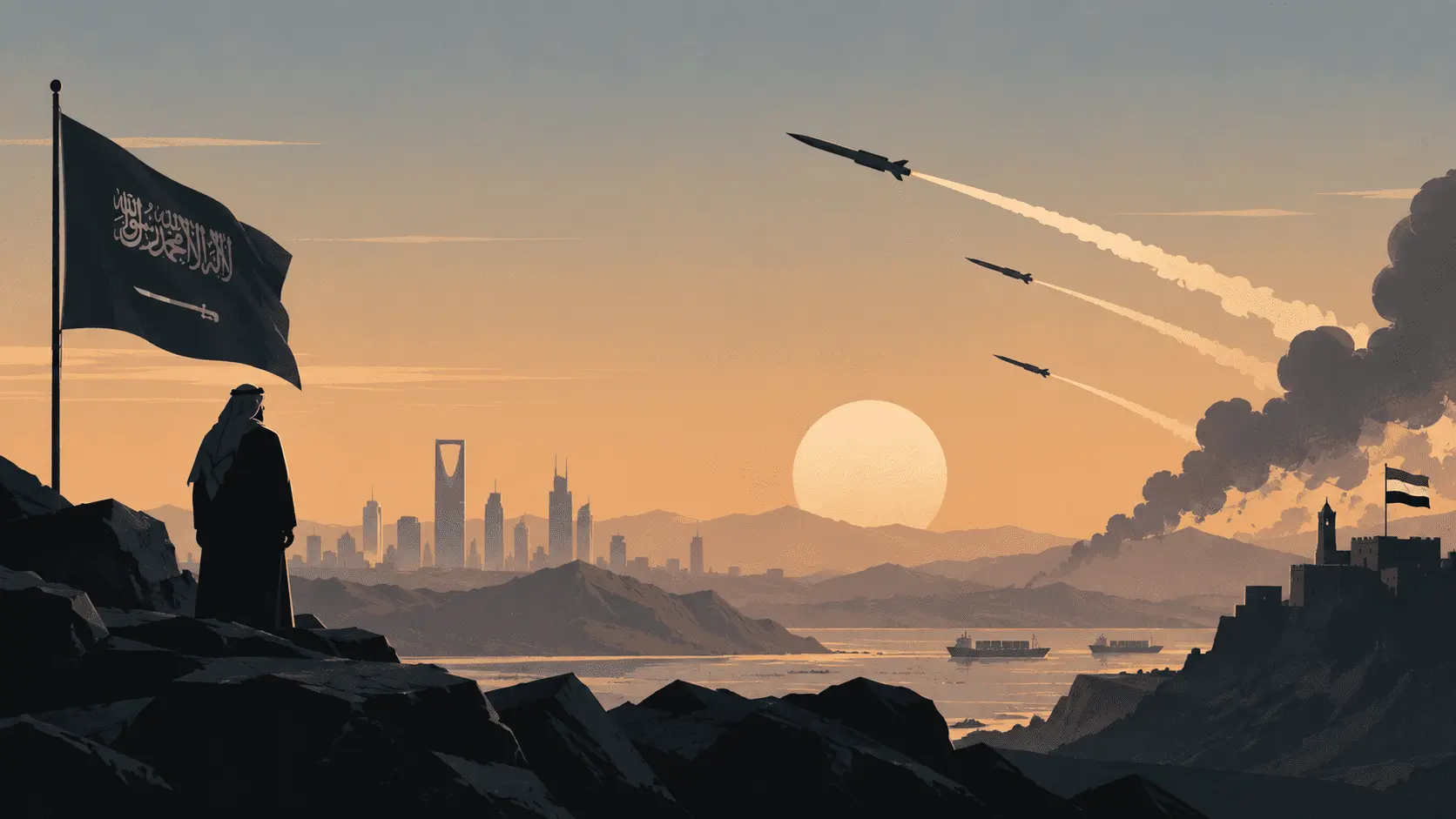
After years of relative calm along its southern frontier, Saudi Arabia is once again facing missiles, drones and an escalating conflict in neighbouring Yemen. The latest fighting is no longer only about Yemen. It is unfolding inside a much larger regional war involving Iran, and it now threatens both of the world's most important oil chokepoints at the same time.
For several years, Saudi Arabia appeared to be moving away from the war in Yemen.
The conflict had never formally disappeared, but after a UN-brokered truce in 2022, direct attacks between Saudi Arabia and Yemen's Houthi movement declined significantly. Front lines inside Yemen largely froze, and diplomatic efforts increasingly focused on preventing another major escalation.
That period of relative calm is now under serious pressure. Over the past week, Houthi forces have launched missiles and drones towards targets across Saudi Arabia, while Saudi-backed forces have intensified military operations against Houthi positions in Yemen. Saudi authorities have issued security alerts across several parts of the kingdom, including Jeddah and, for the first time since 2017, Mecca.
On the evening of September 16, the Saudi-led coalition said its air defences had intercepted a Houthi drone south of Mecca before it entered restricted airspace over the holy city. A coalition spokesperson called the security of Mecca's holy sites a red line. A Houthi military source rejected the claim, saying there was no threat directed at Mecca or any other holy site.
The confrontation that Saudi Arabia spent years trying to contain is becoming active again, and this time it is happening inside a much bigger regional war that most of the outside world is already watching closely.
How did Saudi Arabia and the Houthis get here?
The roots of the conflict go back more than a decade.
The Houthis, formally known as Ansar Allah, took control of Yemen's capital Sanaa in 2014 as Yemen's political order collapsed. Saudi Arabia entered the war militarily in 2015 at the head of a coalition supporting Yemen's internationally recognised government.
Iran has provided support to the Houthis, while Tehran and the group reject characterisations that reduce the Houthis to simply being an Iranian proxy. The relationship nevertheless made Yemen one of the major arenas of regional competition between Saudi Arabia and Iran.
Years of fighting followed. Saudi cities and infrastructure were targeted by Houthi missiles and drones, while Saudi-led airstrikes hit targets throughout Yemen. The conflict also produced an enormous humanitarian crisis.
Then came 2022. A UN-mediated truce significantly reduced large-scale fighting, and although the formal agreement eventually expired, much of the de-escalation held, roughly four years of relative quiet along the Saudi-Yemen frontier.
This is unfolding inside a much larger war
To understand why this particular escalation matters so much, it helps to understand what else has been happening in the region this year.
Since late February 2026, the United States and Iran have been in an active war, one that has already lasted longer than either side initially expected. The Strait of Hormuz, the narrow waterway between Iran and Oman through which roughly a fifth of the world's oil normally passes, has been largely closed since the war began, after Iran's Revolutionary Guard announced it was shutting the strait to vessels travelling to or from the United States, Israel and their allies.
A ceasefire in April briefly paused the fighting, and a memorandum of understanding signed in June outlined a path to end the war and reopen Hormuz over roughly sixty days. That agreement collapsed on July 8, when Iran began targeting commercial vessels in the strait to assert its claim over it. Fighting has continued since, including a large Iranian missile and drone barrage in early September that struck targets in Jordan, Bahrain, Kuwait and Iraq following renewed US strikes on Iran.
That is the backdrop the Houthi escalation against Saudi Arabia is now unfolding within. It is not a separate, unrelated conflict. It is a second front opening while the region's other major oil chokepoint is already effectively closed.
The conflict returned in July
The current Saudi-Houthi escalation did not begin this week.
In July, the Houthis launched missiles towards southern Saudi Arabia, including an attack aimed at Abha airport, after accusing Saudi Arabia of striking Sanaa airport. Reuters described those attacks as breaking roughly four years of relative calm between the two sides.
The situation deteriorated further as the broader regional confrontation involving Iran expanded through August. By September, the conflict had moved into a much more dangerous phase, with Houthi forces launching attacks against Saudi territory and energy infrastructure while advancing rapidly inside Yemen, and Saudi-backed Yemeni forces responding on the ground.
Saudi Arabia had again become directly exposed to a war it had spent years attempting to de-escalate, only this time alongside an active war between the United States and Iran that was already reshaping the region's oil map.
Why the Houthi advance inside Yemen matters
The most consequential developments may actually be happening inside Yemen itself.
On September 10 and 11, Houthi forces seized the strategic port city of Mocha on Yemen's Red Sea coast, then rapidly pushed south to take the rest of the coastline along with Perim Island, which sits in the middle of the Bab al-Mandeb Strait, and the Hanish Islands further north. The advance effectively gave the Houthis control of Yemen's entire Red Sea coastline and the waters around the strait within a matter of days.
That geography changes everything. Bab al-Mandeb is the narrow waterway separating Yemen from Djibouti and Eritrea, and ships travelling between the Indian Ocean and the Suez Canal normally pass through it. It is one of the world's critical maritime chokepoints for oil, container traffic and other goods moving between Asia, the Middle East and Europe.
With the Strait of Hormuz already largely closed by the US-Iran war, Bab al-Mandeb had become one of the Gulf's remaining reliable outlets. Houthi control over the strait's approaches now puts that route under pressure too, which is why analysts have described the Houthi advance as leaving Gulf states with an uncomfortable choice.
Saudi Arabia's oil infrastructure is part of the conflict
Saudi Arabia sits at the centre of the global energy system, which makes its oil infrastructure both strategically important and vulnerable during a regional conflict.
One particularly important piece of infrastructure is the kingdom's East-West pipeline, a 1,200-kilometre route built decades ago specifically so Saudi oil could move overland to the Red Sea if the Strait of Hormuz was ever closed. With Hormuz shut for most of this year, the pipeline had been carrying an estimated four to five million barrels a day, four to five percent of global oil supply, making it the kingdom's main escape valve.
On September 10 and 11, drone strikes launched from Iraqi territory hit the pipeline, causing fires at pumping stations and forcing Saudi Arabia to shut it down as a precaution. Iraq's government confirmed the drones had been launched from Maysan governorate in southern Iraq, where Iran-aligned militias operate, and dismissed a military commander over the incident, though no group has formally claimed the attack. Regional officials have told the Associated Press that Houthi forces helped plan and execute the strike alongside the Iraqi militias.
That leaves Saudi Arabia in a genuinely difficult position. Hormuz has been largely closed for months because of the US-Iran war. The kingdom's overland alternative has now been knocked offline by a drone strike. And the Houthis are simultaneously tightening their grip on the Red Sea route the pipeline was built to reach. Three routes, one crisis.
Oil markets have responded accordingly. Some physical crude cargoes in Europe were trading above $130 a barrel by September 15, nearing the record levels seen earlier in the year, as buyers sought alternatives to Middle Eastern supply affected by the overlapping disruptions.
Why are the Houthis attacking Saudi Arabia again?
The Houthis describe their attacks as retaliation for military action against them and for Saudi support of Yemen's internationally recognised government. Saudi Arabia, meanwhile, accuses the Iran-aligned movement of attacking civilian areas, military installations and strategic infrastructure.
The latest escalation has become intertwined with the wider regional conflict involving Iran, which makes the situation considerably more complicated than the earlier Saudi-Houthi confrontation. Saudi Arabia is no longer dealing only with an insurgent movement across its southern border. It is dealing with an armed group that now controls significant territory in Yemen, possesses missiles and drones, holds positions around one of the world's most important shipping lanes, and is operating within a broader regional war that is already reshaping how oil moves around the Gulf.
Saudi Arabia's difficult choice, and Washington's reluctance
Riyadh is balancing two objectives that increasingly conflict with one another. It wants to protect Saudi territory, energy infrastructure and shipping routes, but it also has strong reasons to avoid returning to the kind of prolonged military involvement in Yemen that characterised much of the previous decade.
Crown Prince Mohammed bin Salman has reportedly called President Trump more than once in recent days, urging direct US strikes on Houthi positions as they closed in on Bab al-Mandeb. According to multiple reports, Trump has so far declined to commit US forces to direct strikes, instead offering intelligence sharing and targeting support, with roughly 200 US military personnel already in the kingdom providing non-combat assistance.
That leaves Saudi Arabia largely on its own in responding to the immediate threat, even as the war shaping the wider region continues without a clear resolution in sight.
What does this mean for the UAE?
For the UAE, developments in Saudi Arabia and Yemen are geographically close and economically relevant.
The immediate significance is not a direct military threat to Dubai or Abu Dhabi. It is the broader regional environment. Both the Strait of Hormuz and Bab al-Mandeb are crucial to Gulf trade, and disruption to either, let alone both at once, can affect oil prices, shipping costs, insurance premiums, airline routing and supply chains across the region.
The UAE also has a long history of involvement in Yemen and maintains significant political and economic interests around the Red Sea. So although the fighting is centred elsewhere, its economic consequences can spread quickly across the Gulf.
Is Saudi Arabia officially at war?
This is where terminology matters.
It would be misleading to describe the situation simply as a new conventional Saudi war, or to treat it as separate from what is already happening between the United States and Iran. Saudi Arabia and the Houthis never reached a comprehensive peace agreement ending their previous confrontation, what existed was a prolonged period of de-escalation, and that de-escalation is now breaking down inside a much larger regional conflict that has already been running for months.
Saudi-backed forces and the Houthis are fighting inside Yemen, Houthi missiles and drones are again being launched towards Saudi territory, and Saudi Arabia is taking military and defensive measures in response, all while the Strait of Hormuz remains largely closed because of the separate war between the United States and Iran.
The more accurate description is that the Saudi-Houthi conflict has sharply re-escalated as one part of a much wider Middle Eastern war.
What happens next?
The next few weeks will matter.
If attacks on Saudi territory continue, Riyadh may increase military pressure on Houthi-controlled areas, with or without direct US support. If the Houthis consolidate their position around Yemen's Red Sea coastline, maritime security around Bab al-Mandeb will become an even larger international concern. And if disruption around both Bab al-Mandeb and Hormuz continues simultaneously while repairs to the East-West pipeline are still weeks away, the consequences will increasingly be felt far beyond the Gulf.
Oil markets are already responding. Shipping routes are already under pressure. And after several years in which diplomacy appeared to be gradually pushing Saudi Arabia away from the Yemen war, the kingdom once again finds itself confronting the same fundamental problem on its southern border, only this time inside a war that is much larger than Yemen alone.
Questions
Is Saudi Arabia at war with Yemen again?
Not in the form of a formally declared war. Saudi Arabia and the Houthis never signed a comprehensive peace deal after their earlier conflict, and the de-escalation that followed a 2022 UN-brokered truce is now breaking down, with Houthi missile and drone attacks on Saudi territory and Saudi-backed operations against Houthi positions in Yemen both intensifying since July 2026.
Why is this escalation different from the earlier Saudi-Houthi war?
It is happening alongside an active war between the United States and Iran that has largely closed the Strait of Hormuz since February 2026. The Houthis have also seized Yemen's Red Sea coastline and the islands around the Bab al-Mandeb Strait, and a drone strike attributed to Iran-aligned militias in Iraq knocked out Saudi Arabia's main overland oil pipeline, putting pressure on multiple routes at once.
What is the Bab al-Mandeb Strait and why does it matter?
It is the narrow waterway between Yemen and the Horn of Africa that ships use to move between the Indian Ocean and the Suez Canal. With the Strait of Hormuz largely closed due to the US-Iran war, Bab al-Mandeb has become one of the Gulf region's remaining major oil and shipping routes, which is why Houthi control over the strait's approaches is significant.
Has the US agreed to strike the Houthis on Saudi Arabia's behalf?
As of mid-September 2026, no. Saudi Crown Prince Mohammed bin Salman has reportedly asked President Trump directly for US strikes on Houthi positions, but Washington has so far limited its involvement to intelligence sharing and targeting support rather than direct military action.
What does this mean for the UAE and the wider Gulf?
The UAE faces no direct military threat from the fighting itself, but disruption to either the Strait of Hormuz or Bab al-Mandeb, let alone both at the same time, can raise oil prices, shipping costs and insurance premiums across the Gulf, given how central both routes are to regional trade.

Dolly Parton, Country Music Icon and Philanthropist, Dies at 80
The legendary singer, songwriter, actress and humanitarian leaves behind a six-decade legacy that reached far beyond country music.

Abu Dhabi Confirmed to Host the 2026 F1 Season Finale
F1's chief executive has ended weeks of uncertainty, confirming the season finale stays at Yas Marina Circuit this December.

Dubai's Iconic Toyota Building to Be Demolished in 2027
The Toyota Building on Sheikh Zayed Road is set for demolition in 2027 after more than 50 years. Here's the story behind Dubai's most nostalgic landmark.