Dubai’s Economy Reaches AED473 Billion. The Sectors Driving It Are Changing.
Real GDP fell 2.3% to AED473 billion, but finance, healthcare, technology and construction kept growing while trade and transport contracted.
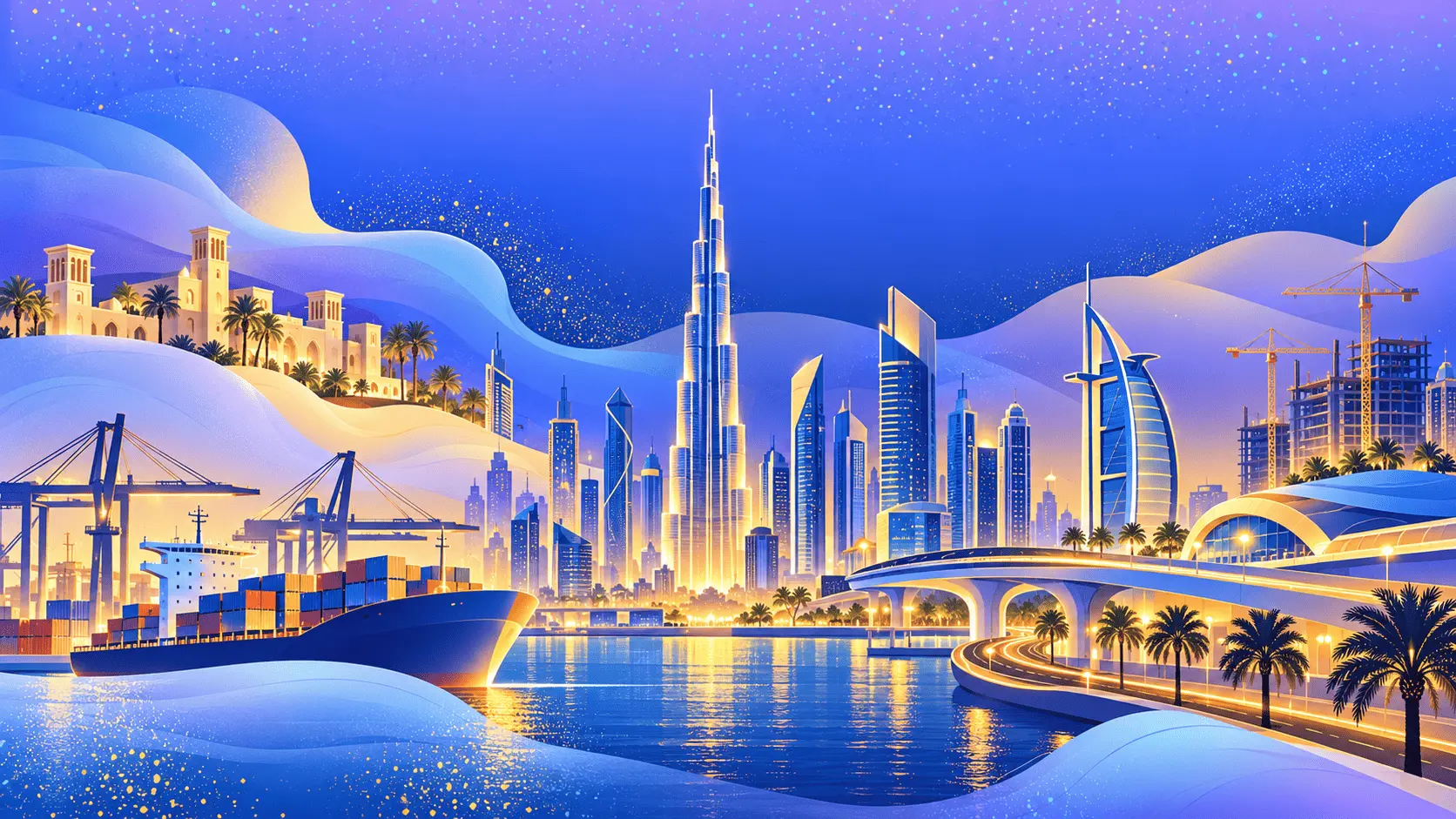
Dubai's economy reached AED473 billion in real GDP during the first six months of 2026, as strong growth in finance, healthcare, technology and construction helped offset pressure on trade, transport and real estate. The latest figures show a city still expanding in key future-facing sectors, even as regional disruption weighed on overall growth.
Dubai has released its latest economic figures, offering a clearer picture of how the city performed through one of the more challenging periods for regional trade and travel in recent years.
According to data from the Dubai Data and Statistics Establishment at Digital Dubai, real GDP reached approximately AED473 billion in the first half of 2026. That compares with AED484 billion during the same period in 2025, a 2.3% decline in real terms. GDP at current prices, however, edged up 0.2% to around AED505 billion.
The headline number therefore tells only part of the story. Several of Dubai's fastest-growing sectors continued to expand strongly, particularly financial services, healthcare, information and communications, and construction.
Finance is becoming an even bigger part of Dubai's economy
Financial and insurance activities were among the strongest-performing sectors during the first half of the year.
The sector expanded 8.8% in real terms, generating approximately AED65.9 billion in value added. Its share of Dubai's economy increased to roughly 14%, up from 12.5% during the same period a year earlier, making it the second-largest contributor to the economy after wholesale and retail trade.
That growth reflects the continued expansion of Dubai as an international financial centre. The Dubai International Financial Centre has continued attracting banks, asset managers, fintech companies, professional-services firms and family offices, and The National reports that the number of companies operating from DIFC exceeded 10,000 during the first half.
For Dubai, this is particularly important because finance is increasingly becoming one of the city's largest high-value sectors rather than simply a service supporting trade and real estate.
Healthcare was the fastest-growing major sector
Healthcare and social work recorded the strongest percentage growth among Dubai's major expanding sectors.
Economic activity in the sector increased 14.3% year on year, with its contribution rising from approximately AED5.4 billion to AED6.2 billion. That growth reflects the broader expansion of private healthcare, specialist clinics, medical tourism and health-related services across the emirate.
It is also another sign of Dubai's changing economic structure. The city's growth story is increasingly spread across sectors that did not historically dominate its economy.
Technology continued to expand
Information and communication activities grew 2.7%, reaching approximately AED24.7 billion during the first half.
That includes activity across telecommunications, digital services, software, cloud infrastructure and other technology-related industries. Dubai has spent several years positioning itself as a regional base for technology companies, particularly in areas such as artificial intelligence, fintech, digital commerce and enterprise software. Those sectors are becoming increasingly important as the city attempts to build more high-value, knowledge-based economic activity alongside its traditional strengths.
Construction remained positive
Construction grew 2.4% in real terms, contributing approximately AED33.2 billion to Dubai's economy during the period.
That expansion comes while Dubai continues to invest heavily in housing, aviation, transport and urban infrastructure. The National reports that approximately AED2.1 trillion in projects are moving forward across those areas, including the long-term expansion of Al Maktoum International Airport.
Those projects matter because construction spending often creates effects well beyond the sector itself. Airports create tourism capacity. Metro and road networks support new communities. Housing supports population growth. And large infrastructure projects can create new commercial districts around them.
But some of Dubai's biggest sectors contracted
The first-half figures also show clearly where the pressure came from.
Wholesale and retail trade, Dubai's single largest economic activity, declined 6% in real terms, although it still accounted for approximately 20.5% of GDP and rose 2% at current prices. Transport and storage fell 7.4%. Real estate activities contracted approximately 2.5% in real terms, although they grew 5.4% to AED65.1 billion when measured at current prices. Manufacturing slipped around 0.9%.
Those declines explain why overall real GDP fell despite significant growth elsewhere.
Regional disruption weighed heavily on travel and trade
One of the major reasons for the slowdown was regional instability during the first half of the year.
The National reports that the Iran war, which began on February 28, disrupted regional travel and trade, putting pressure on sectors including tourism, aviation, logistics and commerce. Dubai is unusually exposed to those sectors because it functions as a major global aviation, trade and logistics hub. When regional airspace, shipping routes or business travel are disrupted, the impact can appear quickly in economic data.
The UAE experienced a similar slowdown nationally. Real GDP across the country grew just 0.4% in the first half of 2026, reaching AED961.9 billion, while non-oil GDP expanded 1.8% and reached 79.2% of the total. Dubai's figures therefore sit within a wider regional economic context rather than representing an isolated local slowdown.
Dubai's economy is becoming more diversified
The most interesting part of the latest figures is not simply whether GDP moved up or down. It is which sectors are becoming more important.
For decades, Dubai's economy has been associated primarily with trade, aviation, tourism, real estate and construction. Those sectors remain enormous. But finance, healthcare, technology and professional services are taking a larger share of the economy.
Dubai H1 2026: key sectors
| Sector | H1 2026 real growth |
|---|---|
| Healthcare and social work | +14.3% |
| Financial and insurance | +8.8% |
| Electricity, water and waste | +5.4% |
| Government services | +2.9% |
| Information and communication | +2.7% |
| Construction | +2.4% |
| Education | +1.2% |
| Manufacturing | -0.9% |
| Real estate | -2.5% |
| Wholesale and retail trade | -6.0% |
| Transport and storage | -7.4% |
Figures are based on first-half data released by Digital Dubai and reported by Gulf News, WAM and The National.
The contrast is important. Some of Dubai's traditional economic engines weakened during the first half, while several sectors associated with the city's next phase of development continued growing. That is what economic diversification looks like in practice.
The first quarter had looked considerably stronger
Dubai's first-quarter figures had initially shown more momentum. Real GDP reached approximately AED232 billion in Q1 2026, representing annual growth of 2.4%.
The first-half figure therefore implies a much weaker second quarter. By simple arithmetic on the published figures, that points to a second-quarter decline of roughly 6% year on year, though Digital Dubai has not published that number directly. That broadly aligns with the national picture, where UAE real GDP fell 2.1% year on year in Q2 as regional disruption affected tourism, transport and trade.
This makes the timing of the slowdown particularly important. Rather than indicating uniform weakness throughout the year, the figures point toward a sharper disruption during the second quarter.
Dubai is still investing heavily into the next cycle
The city is continuing to pursue the Dubai Economic Agenda D33, which aims to expand Dubai's economy, strengthen its position as a global business centre and deepen activity across technology, trade, finance and advanced industries.
At the same time, the government continues to invest in infrastructure at a scale designed around long-term population and business growth. Al Maktoum International Airport is one of the largest examples. Transport networks are expanding. New residential districts continue to develop. Digital-commerce infrastructure is also growing, including a recently announced AED1.8 billion expansion of Dubai CommerCity, according to The National.
The strategy appears to be straightforward, continue building capacity even during periods of weaker short-term growth.
What the AED473 billion figure actually tells us
GDP headlines can sometimes oversimplify economic performance. Saying Dubai's economy reached AED473 billion sounds positive. Saying it declined 2.3% sounds negative. Both are true. The more useful interpretation lies between them.
Dubai experienced a noticeable slowdown during the first half of 2026, driven particularly by external disruption affecting trade, transport and other internationally exposed sectors. At the same time, finance, healthcare, technology and construction continued expanding. That suggests the city's economic base is broader than it was during previous regional disruptions. The sectors under pressure remain extremely important. But they are no longer carrying the economy alone.
A city increasingly built around several economies at once
Modern Dubai is difficult to describe through a single industry. It is simultaneously a tourism destination, financial centre, aviation hub, logistics platform, property market, technology base, healthcare destination and regional headquarters economy.
That complexity can create vulnerability when global events affect several sectors at once. But it can also provide resilience. When transport contracts, finance can grow. When trade weakens, healthcare or technology can continue expanding. That balance may ultimately be one of the most important developments in Dubai's economic transformation.
The AED473 billion first-half figure therefore represents more than an economic milestone. It shows an economy going through pressure while its internal structure continues to change. And increasingly, Dubai's growth story is no longer simply about how large the economy becomes. It is about what the economy is becoming.
Questions
What was Dubai's GDP in the first half of 2026?
Dubai's real GDP reached approximately AED473 billion in the first half of 2026, down 2.3% from AED484 billion a year earlier. At current prices, GDP rose 0.2% to around AED505 billion.
Which Dubai sectors grew the fastest?
Healthcare and social work grew 14.3%, financial and insurance activities grew 8.8%, and information and communication, construction and government services also expanded.
Which Dubai sectors contracted?
Transport and storage fell 7.4%, wholesale and retail trade fell 6%, real estate contracted 2.5% in real terms, and manufacturing slipped 0.9%.
Why did Dubai's economy slow in the first half of 2026?
The National reports that the Iran war, which began on February 28, disrupted regional travel and trade, putting pressure on tourism, aviation, logistics and commerce, sectors where Dubai is highly exposed.
How big is finance in Dubai's economy now?
Financial and insurance activities generated about AED65.9 billion and accounted for roughly 14% of Dubai's economy in the first half, up from 12.5% a year earlier.
Dubai Is Looking for the Arab World’s Next Hope Maker. The Prize Is AED1 Million.
Nominations are open for the seventh Arab Hope Makers, with AED1 million for the winner and a call for people across the Arab world to put forward those making a difference.
The Indian Rupee Under Pressure: Why India's Currency Is Struggling in 2026
The rupee is hovering near record-weak levels as oil prices, geopolitical tensions, and importer demand weigh on it, with RBI intervention and billions in new inflows providing a buffer.

Top 10 Interior Design Companies in Dubai (2026): A Verified Guide
Instead of repeating the self-ranked "top 10" lists that dominate this search (where nearly every result is a design firm naming itself #1), this guide cross-checked independent, verified sources: Clutch review data, real industry awards, and consistent mentions across multiple independent sources rather than one company's own marketing. The ten firms that held up, each with what they're actually best for: