Etihad Rail Is Coming to Dubai: What Changes From September 30
On September 30, Etihad Rail's Dubai station opens at Al Yalayis, connecting the city to a national passenger railway for the first time and linking it to Abu Dhabi, Sharjah and beyond.
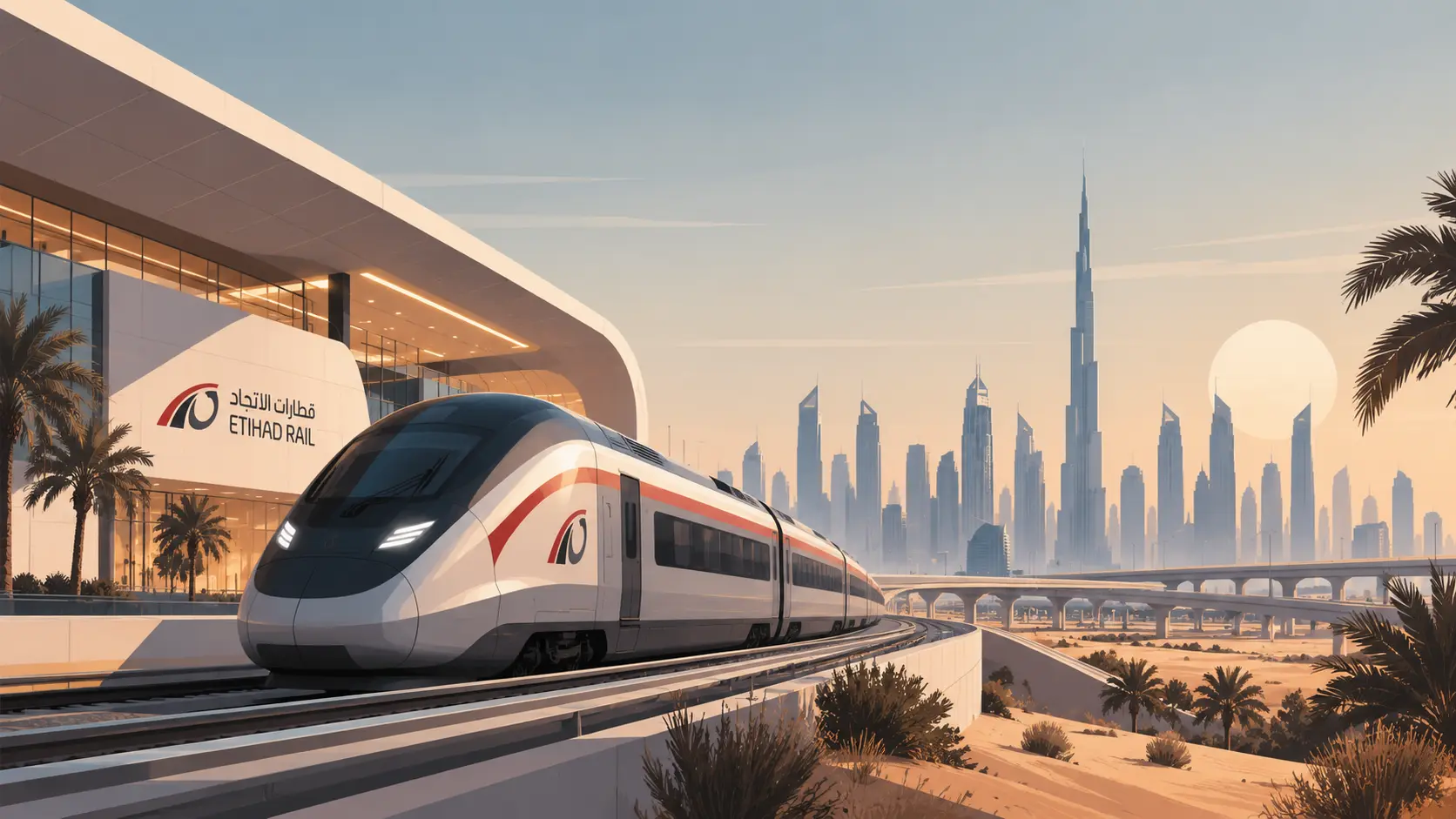
Dubai is about to gain something it has never had before, a place on a national passenger railway. On September 30, Etihad Rail's Dubai station opens at Al Yalayis, connecting the city to a rail network that is beginning to redraw how people move between the Emirates.
For decades, travelling between the UAE's cities has largely meant getting into a car, taking a taxi or boarding an intercity bus. Dubai has built one of the region's most extensive urban public transport systems, but once a journey crossed the emirate's boundary, the car remained dominant.
That begins to change on September 30, 2026.
Passenger rail has already started in the UAE
Technically, the railway era has already begun.
At 5:34am on June 30, Etihad Rail's first scheduled passenger service departed Fujairah for Abu Dhabi. It arrived at Mohammed Bin Zayed City at 7:19am, completing the journey in one hour and 45 minutes. It was the first scheduled national passenger rail service in the UAE.
That initial route has effectively served as the introductory phase before the wider rollout, and demand has been strong. Etihad Rail reported more than 70,000 tickets sold within five weeks of launch, with passengers booking an average of 12 days ahead and several services selling out entirely. The operator said demand was coming from families, business travellers, schools and leisure passengers.
September 30 is the next significant date. It is when the railway reaches Dubai, opening alongside Al Dhaid station in Sharjah.
Where is the Etihad Rail station in Dubai?
Dubai's passenger station, known as Al Yalayis station, sits inside Jumeirah Golf Estates, directly along Sheikh Mohammed Bin Zayed Road, placing it close to the existing Dubai Metro Red Line corridor.
This matters because the usefulness of an intercity railway depends heavily on what happens after passengers step off the train. Rather than functioning as an isolated station on Dubai's outskirts, the location is intended to integrate with the city's wider transport network. The Etihad Rail station sits roughly four minutes from the existing Jumeirah Golf Estates Metro station, and a footbridge connecting the two is currently under construction.
That creates the possibility of journeys that previously required a car becoming predominantly public transport. A passenger arriving in Dubai could continue by Metro towards areas including Dubai Marina, JLT, Downtown Dubai, Business Bay or Dubai International Airport through the wider Metro network.
The significance isn't simply having a railway station. It is connecting national rail with local transport, and once the two are linked, the Dubai to Abu Dhabi journey by rail is expected to take around 57 minutes.
Why September 30 matters for Dubai
Dubai already has Metro, Tram, buses, taxis and an expanding network of cycling and pedestrian infrastructure.
Etihad Rail fills a different gap.
The Metro moves people around Dubai. Etihad Rail is designed to move people between the Emirates. That distinction could gradually change how residents think about distance.
Living in one emirate and working in another is already normal for many UAE residents. But those journeys are largely dictated by traffic conditions. Rail introduces something different, predictability. Instead of asking how congested Sheikh Zayed Road or another highway might be at a particular time, passengers can plan around a timetable.
Etihad Rail itself describes passenger rail as an additional travel choice rather than a replacement for existing transport, with reliability and predictable inter-emirate movement among its central aims.
The railway could make the UAE feel smaller
This may eventually be the most important consequence.
The UAE is geographically compact, yet the way its cities have developed can make them feel more separated than the map suggests. Dubai, Abu Dhabi, Sharjah and Fujairah have their own employment centres, neighbourhoods, universities, cultural institutions and tourism economies.
A national railway begins to connect those individual urban systems. Suddenly, living in one city while regularly travelling to another becomes easier to imagine without every journey depending on a private vehicle.
That could have consequences beyond transportation. It could influence where people choose to live, where companies recruit employees, where families spend weekends, which destinations tourists visit, and even how businesses think about their potential customer base.
A railway does not simply shorten a journey. Over time, it can change what people consider to be within reasonable reach.
What will Etihad Rail trains be like?
Etihad Rail's passenger fleet consists of 13 trains, each capable of carrying up to 400 passengers, with operating speeds of up to 200 km/h.
Stations are also being designed as more than functional boarding points. Etihad Rail says they will include cafes, restaurants, retail outlets and other passenger facilities, while dining options will also be available onboard.
The existing Abu Dhabi to Fujairah service currently offers Comfort and Premium classes, with introductory fares starting at AED 55 for Comfort Class and AED 120 for Premium Class, though Dubai specific fares should be treated separately once confirmed for the new routes.
Tickets are available through Etihad Rail's digital booking channels, including its website and mobile application.
Dubai isn't the end of the rollout
September is one stage of a much larger network.
The current rollout has Dubai and Al Dhaid opening on September 30. Etihad Rail then plans to open the Madinat Zayed and Liwa stations in the Al Dhafra region on November 30, brought forward a month early to coincide with the region's festival season. The remaining Al Dhafra stations, at Al Sila, Al Dhannah and Mirfa, follow on December 30.
Sharjah's University City station, the network's eleventh and final stop, is scheduled for March 30, 2027.
The network is therefore arriving progressively rather than appearing overnight, and Etihad Rail expects annual ridership to exceed 36.5 million passengers by 2030 once the full eleven station network connecting 11 cities and locations, from Al Sila to Fujairah, is complete.
A different kind of UAE commute
The immediate temptation is to judge Etihad Rail by a simple question, is it faster than driving?
But that may not be the most interesting measure.
Driving between cities requires attention for the entire journey. Rail gives that time back. A passenger can work, read, watch something, have a conversation, or simply look out of the window.
For business travellers in particular, that distinction matters. Ninety minutes behind a steering wheel and ninety minutes sitting on a train may occupy the same amount of time on a clock, but they are not the same ninety minutes.
And as more stations open, the railway could make journeys that currently feel inconvenient become ordinary.
Dubai's railway era begins September 30
Dubai has spent decades building infrastructure around movement. Highways connected emerging districts. Dubai Metro changed how people moved through the city. The Tram added another layer to the Marina corridor.
Etihad Rail represents the next scale of that idea. Not neighbourhood to neighbourhood. Not station to station within Dubai. Emirate to emirate.
The first passenger trains are already running elsewhere in the country. More than 70,000 tickets were sold within the early phase. Now the network is approaching the point when Dubai becomes part of it.
On September 30, 2026, the opening of Dubai's Etihad Rail station will be more than another transport launch. It will be the day Dubai becomes connected to the beginnings of a national passenger railway.
And in a country where the car has defined intercity movement for generations, that could eventually change far more than the commute.
Questions
When does the Etihad Rail Dubai station open?
Dubai's Al Yalayis station, located in Jumeirah Golf Estates, opens on September 30, 2026, alongside Al Dhaid station in Sharjah.
Where is the Dubai Etihad Rail station located?
The station sits inside Jumeirah Golf Estates along Sheikh Mohammed Bin Zayed Road, roughly four minutes from the existing Jumeirah Golf Estates Metro station, with a footbridge under construction to connect the two.
How fast is Etihad Rail and how much does it cost?
Trains run at speeds of up to 200 km/h and carry up to 400 passengers each. On the existing Abu Dhabi to Fujairah route, introductory fares start at AED 55 for Comfort Class and AED 120 for Premium Class.
What other Etihad Rail stations are opening soon?
Madinat Zayed and Liwa stations open November 30, the remaining Al Dhafra stations (Al Sila, Al Dhannah and Mirfa) open December 30, and Sharjah's University City station, the network's final stop, opens March 30, 2027.
How long will the train journey between Dubai and Abu Dhabi take?
Once fully connected, the Dubai to Abu Dhabi rail journey is expected to take around 57 minutes.
Dubai Is Coming Back Outside: When the City's Seasonal Attractions Reopen After Summer 2026
Global Village opens October 14, Dubai Safari Park opens October 12, and Miracle Garden, Garden Glow and Ripe Market follow through autumn. Here's every confirmed and expected reopening date for Dubai's 2026-27 outdoor season.
Dubai Landmarks Set for Major Reopenings as the City Enters Its New Season
Global Village and Dubai Safari Park are set to return in October, while the Museum of the Future and Burj Al Arab remain closed for major transformations.
Dubai Is Hiring Again. So Why Is Finding a Job Still So Hard?
The UAE labour market is recovering, but employers are more selective, competition remains intense, and AI is changing what it means to be employable.